How to write a critical essay: step-by-step guide with examples


Indeed you have read books, listened to music, or watched movies at least once. All these art pieces give you certain impressions or desires to discuss certain aspects with someone. Perhaps you even wrote comments on review aggregators, which is technically similar to writing a short critical essay. In this case, writing a critical essay will be easier because you already understand how to discuss ideas and evaluate them.
What is a critical analysis essay?
What is a critical essay and what does a critical analysis essay involve? Imagine that you are faced with such an assignment for the first time and do not know what to do. What is critical analysis essay all about? As a writer, you need to take any book, painting, sculpture, or another piece of art for analysis. Your goal is to analyze the author or artist's points. A critical analysis essay is aimed at a complete analysis of each artistic aspect, the main goal, and the tools to achieve it. Imagine that you have dismantled the house, separating each floor section, brick, roof, and foundation from a common base. After analyzing each part of the house, you will understand what it was created from, and you can even prepare a judgment, pointing out its strengths and weaknesses. Here’s how to write a critical analysis essay step by step. And now, let's check out other important nuances.
Key characteristics of a critical essay
A critical essay differs from descriptive or narrative writing. The goal of a critical essay is to analyze and evaluate ideas rather than simply summarize them.
- Clear thesis statement. At the beginning, the writer presents a specific thesis that explains their interpretation or position on the topic.
- Evidence from sources. Each argument should be supported with references to the original text, research, or other credible sources.
- Focus on analysis. The writer explores and evaluates ideas, themes, or arguments instead of retelling the plot or repeating information.
- Logical organization. Most critical essays follow a clear structure: an introduction with the thesis, body paragraphs with arguments and evidence, and a concluding section.
- Formal and objective tone. The language remains academic and balanced, concentrating on reasoned evaluation rather than personal reactions.
Writing tip from SpeedyPaper
Three types of critical essays
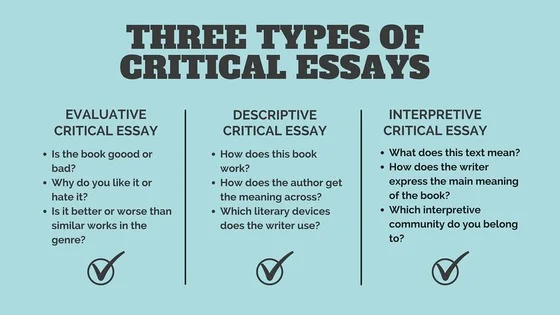
There are three strategies for you to choose from when writing a critical essay. Depending on the approach, your critical essay may require different research and analysis methods. So you should decide on the type of critical essay you wish to write before you start. Your instructor may specify the preferred type of critical essay within the assignment, so pay close attention to the task you are given.
Evaluative critical essay
In this type of critical essay, you judge a work and explain your reasoning with clear standards. Instead of only sharing whether you liked the book, support your view with literary standards, examples from the text, and comparisons to other works. This approach is more like making an argument than just giving a personal response.
Descriptive critical essay
A descriptive critical essay focuses on how a work is structured. In this type of critical essay, you examine the literary devices, techniques, or stylistic choices that shape the text. The goal is to show how these parts contribute to the book’s overall impact.
Writing tip from SpeedyPaper
Interpretive critical essay
An interpretive critical essay explores the deeper meaning of a work and helps the reader understand the message of the critical essay. You pick a viewpoint, like historical, psychological, or social, and use it to analyze the text. With examples and your own interpretation, you show what ideas or messages the author might be sharing.
How to write a critical essay: 6 steps to success
If you want to understand how to write a critical essay, it helps to break the process into simple steps you can follow. As you see, writing is just a single stage, while pre-writing is where you will need to do most of the work.
1. Choosing the right primary source
Not every instructor is willing to let students choose the book or poem to analyze. However, if you are among the few lucky bastards, choose wisely. Pick a work you like and know well, the one you’ve read at least a couple of times and can probably quote your favorite parts. Make your life easier by selecting the right book, and your critical essay will be done in no time.
Writing tip from SpeedyPaper
2. Reading and note-taking
The easiest way to work on a book is by highlighting or underlining the parts you find interesting or entertaining. However, this is not enough. While reading the work, always ask yourself:
- How does this chapter make me feel?
- Which questions arise when I read this book?
- Which methods and devices does the author use to make me feel this way?
- Why can’t I stop laughing or crying when I read this dialog?
The more questions you ask yourself, the easier it will be for you to create an outline and analyze the book. This approach makes it easier to write any analytical essay or coursework. Of course, you can always buy coursework or an essay online if deadlines become overwhelming.
3. Crafting a thesis
The content of your thesis will depend on which type of critical essay you are going to write. Consult our comprehensive guide to write a strong thesis statement for your critical essay. In short, your thesis should answer the central question: “So what?”. Besides just stating the obvious, address the how or the why. Explain to the readers how you came to this conclusion or why they should care about your opinion.
4. Researching secondary sources
If you can’t come up with any ideas for the critical essay, consult professional critics. Read literary discussions or evaluations of the text you have to analyze. These will help you form your own opinion. Research the author’s biography, the historical period of his or her life, political or religious factors that might have influenced the text.
5. Plotting an outline
It is tempting to delve into writing after days of research, but in the end, you risk producing a jumbled mess of unrelated thoughts. So take the time necessary to create a rough outline. List the main points you want to make, use your notes and examples from the primary source to flesh out the body paragraphs. Their number and length will depend on the parameters of your assignment.
6. Writing, editing, and proofreading
After these preparatory steps, you will clearly see how to write a critical essay effectively. All you have to do is put your thoughts into words, and words into sentences and paragraphs. Remember to cite the sources and edit the finished paper carefully. Think about what a professional critic would write after reading your essay. Every typo decreases your credibility, so proofreading is also a must.
Writing tip from SpeedyPaper
Critical analysis essay outline
Think of an outline as a way to organize the arguments and structure of your critical essay. Since the "what is critical analysis essay" question is no longer a problem for you, let's check the key nuances of your outline. Typically, your professor will give you a sample so that you can write a critical analysis essay. But here is a sample that you can use in most cases.
- Background Info: Add some context.
- Info
- Title.
- Author.
- Publication information.
- Statement and purpose
- Thesis statement: After rendering the context, add your reaction to the work.
- Summary: Visualize your understanding of the source.
- Critical Analysis: This is the place for detailed analysis and critical evaluation.
- Visualize the structure and organization of the source.
- Concentrate on style or rhetorical aspects.
- Evaluate the effectiveness of the source and the message you have identified.
- Evaluate the level of impartiality and topic disclosure.
- Discuss the influence of the source on the audience.
As with all other critical analysis essay samples, you need a solid conclusion. Then, summarize your reactions and offer your final thoughts to make your critical analysis essay valuable to the reader (professor).
8 Essential tips for composing a critical essay
Writing a strong critical essay is about more than just sharing your opinions. Your main goal is to analyze and evaluate ideas using logic and evidence. The strategies below will help you organize your thoughts and build a clear, effective essay.
- Start by making sure you fully understand the assignment. Read the prompt closely to figure out exactly what you need to analyze.
- Create a clear thesis statement. This will guide your essay and show the reader your main point.
- Look closely at your source material. Take notes on important arguments, themes, and details that support your analysis.
- Back up each point you make with evidence. Use quotes, examples, and references from the text to make your argument stronger.
- Follow a clear structure. A typical critical essay format includes an introduction, analytical body paragraphs, and a concise conclusion.
- Explain your analysis clearly. Make sure you spell out your reasoning so the reader can follow your ideas easily.
- Stay objective and use a formal academic tone. This helps make your argument more balanced and credible.
- Revise and edit the essay thoroughly. Careful proofreading enhances Take time to revise and edit your essay. Careful proofreading will make your writing clearer and help you share your ideas effectively.
Implementing these strategies will facilitate the organization of ideas and the use of evidence-based arguments. However, if you are short on time, you can always buy analytical essay from our experts to ensure the production of a high-quality paper.
Critical analysis essay topics
Now you know how to start a critical analysis essay and develop a strong critical essay. But there is one more nuance that you should consider. You need to choose a good topic if you want to write a critical analysis fast. The right idea for your paper will help you avoid many pitfalls. Here are the topics that are worth your attention.
- Critical analysis of the new media technology
- Critical analysis and evaluation of text
- A critical analysis of Mr. P's case study
- The Apology (2016) critical analysis
- A critical analysis of the Myth of Model Family
- Dynamic self-concept critical analysis
- Frankenstein critical analysis evaluation
- Critical analysis of book of Addicted to Incarceration
- The critical analysis of Dante's Inferno
- Critically analyze the films, references to social and historical contexts
- I Like to See it Lap the Miles critical analysis
- Phenomenal woman and Barbie doll
- The Odyssey book XI vlose reading and critical analysis
- A critical analysis of the impact of health informatics on healthcare
- The once were warriors movie: a critical analysis
- An analysis of Thank You, Maam by Langston Hughes
- Critical analysis of Compulsive Hoarding from a Holism Approach
- A critical analysis of The War Prayer by Mark Twain
- George Orwell's 1984 using literary criticism
- A Hanging critical analysis
- How do you critically analyze an Article?
- A detailed critical analysis of Sweet Home
- A critical analysis of Cosmo Comics and other literature
- Fast analysis of The Bronze Horseman
- A Dreaming in Cuban and the Latin Deli
- How do you start a critical analysis of an article?
- A critical analysis of Things Falls Apart
- The critical analysis essay on the article A Difficult Balance of Work and Life
Now you understand how to write a critical essay and apply these ideas in practice. Don't be afraid to experiment and choose interesting topics. By the way, you should also check how to write a polished essay so that you don't have any problems in the future.
Critical analysis essay examples
Surely you want to write a critical analysis like a pro and avoid common mistakes. In this case, you need to check out good critical analysis essay examples. This approach is the most efficient as you can craft your essay by comparing it step by step with the example. Here is a good sample that will help you stand out and create a solid critical analysis essay, so don't hesitate.
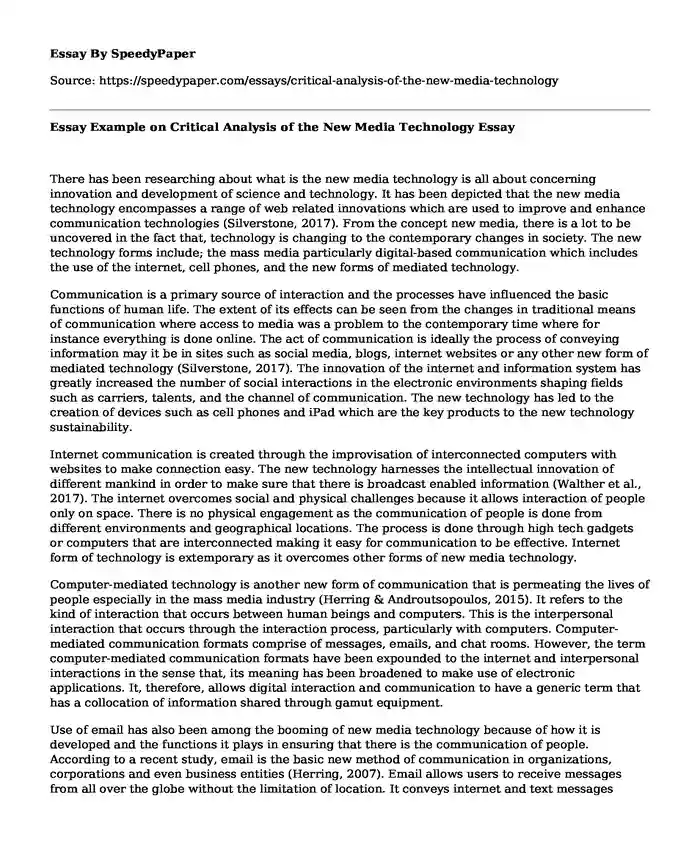
As you can see, looking for good samples can help get more information. Good examples give students an understanding of the essence of such assignments. However, if some academic nuances seem too complicated, you can use a paper writing service for additional academic support.
Conclusion
If you need a critical essay example, check out our database of helpful critical essay samples that can help you stand out and save time. Moreover, you can also check other types of papers and learn how to write a rhetorical analysis essay. We have collected many useful samples and guides for any academic level. What's more, our team of experts will gladly help you with your academic burden. Reach out to our writers and editors, who will gladly improve your paper or create one from scratch to save time. As you can see, your critical analysis essay is in safe hands! Now you can achieve the required academic results!
FAQ
Are all critical essays negative?
No. In academic writing, being “critical” means taking a close look at a work and evaluating it. A critical essay discusses both the strengths and weaknesses of a book, article, or film, and backs up these points with evidence. The main goal is to analyze carefully, not just to praise or criticize.
How long should a critical essay be?
The length of a critical essay depends on your assignment. For most high school or college tasks, it is usually three to five pages, but shorter essays are also common. Always check your professor’s instructions and make sure your argument is clear and supported by evidence.
Can a critical essay be written in the first person?
In most academic critical essays, writers use the third person to keep the tone objective and formal. However, some instructors allow limited use of the first person when explaining your interpretation. If the assignment is a self-critical essay, using “I” may be acceptable. Always follow your instructor’s guidelines.
Related articles