How to Write a Proposal Essay: Step-by-Step Guide, Outline, Topics, and Examples


To write a strong proposal essay, you need to do more than describe a problem. You must present a practical solution, explain how it could be implemented, and convince readers that your plan is realistic, useful, and worth considering.
A proposal essay usually includes an introduction, problem statement, proposed solution, implementation plan, feasibility discussion, expected outcomes, conclusion, and references. Depending on your assignment, you may also need to include a title page, abstract, timeline, budget, or works cited page.
This guide explains how to write a proposal essay step by step, how to structure each section, what mistakes to avoid, and how to choose a topic that leads to a clear problem-solution argument.
What is a proposal essay?
Before you start writing, make sure you understand the assignment. A proposal essay is an academic paper that identifies a specific problem and argues for a practical solution. The goal is to persuade your audience that the issue matters, your plan can work, and the expected results justify the effort.
Unlike a regular argumentative essay, a proposal essay does not stop at proving a point. It also explains what should be done, who should do it, what resources are needed, what challenges may appear, and why the proposed solution is better than leaving the problem unsolved.
Proposal essay vs research proposal
A proposal essay and a research proposal are related, but they are not the same assignment. A proposal essay usually argues for a solution to a real problem, such as improving campus recycling, reducing student stress, or changing a local policy. A research proposal explains what you plan to study, why the research matters, and how you will conduct the study.
If your professor asks for a proposal essay, focus on a problem-solution argument. If the assignment asks for a research proposal, focus on research questions, methodology, literature, and academic contribution.
How to write a proposal essay step by step
A proposal essay works best when each section answers one practical question: What is the problem? Why does it matter? What solution do you suggest? How will it work? What resources are required? What results should readers expect? The steps below show how to move from a broad idea to a focused, persuasive proposal.
Writing tip from SpeedyPaper
Step 1. Choose the best topic for a proposal essay
While in certain instances, college students will be offered a list of topics for proposal essay writing, sometimes learners will have to make the decision independently. Finding the right perspective to discuss is not easy, as it requires a clear understanding of the field, the problem, and the audience that might support the proposed solution.
If you want to choose a relevant essay topic, start with a broad subject and narrow it down to one specific problem. Then ask yourself what realistic solution you can suggest. For example, “student mental health” is too broad, but “how colleges can make mental health support more accessible during exam periods” is focused enough for a proposal essay.
Writing tip from SpeedyPaper
Step 2. Understand the target audience
Before drafting, decide who needs to be persuaded. In a proposal essay, your audience should be someone who can understand, evaluate, support, or act on your solution. This may be a professor, school administrator, local official, business manager, community group, or academic reader.
To define your audience, answer these questions:
- What does the reader already know about the problem?
- What concerns or objections might they have?
- What kind of evidence will they trust?
- What benefits matter most to them?
- What tone will sound credible: formal, practical, academic, or policy-focused?
Once you understand your audience, you can choose stronger evidence, avoid unnecessary explanations, and present your solution in a way that feels realistic rather than vague.
Step 3. Specify the problem
Once you have analyzed the prospective audience, you are ready to define the problem. A strong problem statement should explain what is wrong, who is affected, why the issue matters, and what may happen if no action is taken.
There are several techniques that may help you introduce the main idea of the paper. You can use:
- Real-life examples
- Statistics
- Brief personal anecdotes
- Survey data
- Expert opinions
- Recent reports or case studies
These elements can capture the reader’s interest and build trust. Make sure you support your claims with references and facts from credible sources, just as you would in an expository essay.
Step 4. Research the field
Research is one of the most important stages of proposal essay writing because your solution needs evidence. Use primary and secondary sources to understand the causes of the problem, existing attempts to solve it, and the practical limits of your own proposal.
Avoid outdated information and data from dubious sources. Instead, rely on academic articles, government reports, university resources, reputable news outlets, nonprofit publications, interviews, surveys, or credible case studies. If your professor requires a specific citation style, keep track of your sources from the beginning so that the reference list is easier to prepare later.
Step 5. Create a proposal essay outline
Finally, you are getting closer to the proposal essay writing process, and outlining is one of the most effective ways to make the assignment more manageable. An outline helps writers structure the paper and keep the proposal consistent, logical, and easy to follow.
A strong proposal essay outline usually includes:
- Introduction with a hook, background, and thesis statement
- Problem statement explaining what is wrong and who is affected
- Proposed solution describing the main plan
- Implementation plan showing the steps, timeline, and responsible people
- Feasibility section covering cost, resources, risks, and limitations
- Expected outcomes explaining the benefits of the solution
- Counterarguments or objections with reasonable responses
- Conclusion with a final argument and call to action
- References or works cited page
Brainstorm ideas and techniques that will help you create a comprehensive proposal essay. Check out a few sample papers to detect useful tips and tricks that may contribute to the quality of your writing.
Make sure the proposal essay outline you create presupposes the logical flow of ideas. Include transition sentences and phrases that will keep the text consistent and coherent.
Here is a simple proposal essay structure you can use before drafting:
| Section | Purpose | What to include |
|---|---|---|
| Introduction | Introduce the issue and your proposal | Hook, background, thesis statement |
| Problem statement | Prove that the problem matters | Causes, effects, affected groups, evidence |
| Proposed solution | Present your main idea | Clear solution, goal, reason it fits the problem |
| Implementation plan | Show how the solution will work | Steps, timeline, stakeholders, responsibilities |
| Feasibility | Prove the plan is realistic | Cost, resources, possible risks, limitations |
| Expected outcomes | Explain the value of your proposal | Benefits, measurable results, long-term impact |
| Counterarguments | Address reader doubts | Objections, trade-offs, alternative views |
| Conclusion | Reinforce your proposal | Summary, final benefit, call to action |
Writing tip from SpeedyPaper
Step 6. Open your proposal strong
The introductory passage provides background information on the proposal. It introduces the problem, gives readers enough context to understand the issue, and leads them toward your proposed solution. Therefore, the primary task of the writer is to keep this passage well-structured, easy to read, and focused.
An introduction should include:
- A hook. Start with a striking fact, brief example, question, or situation that shows why the problem matters.
- Background information. Help readers understand the context of your topic, especially if they are new to the issue.
- A clear thesis statement. State the problem and the proposed solution in one focused sentence.
A strong proposal essay thesis should name the problem and present the proposed action. For example: “To reduce food waste on campus, the university should introduce a dining hall donation program that sends unused prepared food to local shelters each evening.”
A separate passage should hold the problem statement, including:
- The main issue
- The people or groups affected by the problem
- The causes and consequences of the issue
- Evidence that proves the problem is real
- Limitations or conditions that affect possible solutions
Step 7. Explain your solution and implementation plan
The body of a proposal essay should make your solution easy to understand and evaluate. Start by stating the solution in one or two clear sentences. Then explain the steps required to put it into action.
A strong implementation plan answers these questions:
- What actions need to happen first?
- Who will be responsible for each step?
- What timeline is realistic?
- What materials, tools, funding, or support are required?
- What obstacles could slow the plan down?
- How will success be measured?
For example, if your proposal is to reduce plastic waste on campus, your plan might include installing refill stations, replacing single-use containers, launching a student awareness campaign, and tracking waste reduction over one semester. Specific details make the proposal more persuasive than a general claim that the school should “be more sustainable.”
Step 8. Address objections and limitations
A persuasive proposal essay should not ignore possible objections. Readers may question the cost, timeline, practicality, fairness, or evidence behind your solution. Addressing these concerns shows that you have considered the issue from more than one angle.
You can address objections with phrases such as:
- One possible concern is...
- Critics may argue that...
- This limitation matters because...
- However, the proposal remains practical because...
- A realistic way to reduce this risk is...
For example, a campus recycling proposal may face objections about cost. You could respond by explaining how the school could start with a pilot program in one building, measure results, and expand only if the first stage is successful.
Step 9. Evaluate feasibility, resources, and expected outcomes
After explaining your solution, prove that it can work in real conditions. This section should cover the practical side of your proposal: time, cost, resources, people involved, and possible limitations.
Answer these questions:
- How long will the plan take to implement?
- What resources or funding are required?
- Who needs to approve, manage, or support the plan?
- What challenges could appear?
- What results would show that the solution worked?
Expected outcomes should be specific. Instead of writing, “This plan will help students,” explain what kind of improvement readers can expect: fewer missed deadlines, lower costs, better attendance, reduced waste, improved safety, or stronger academic support.
Step 10. Wrap up your proposal essay
The final part of the essay should contain zero new information. The main idea of the conclusion is to sum up the core ideas, restate the value of your solution, and leave readers with a clear reason to support the proposal.
Do not simply repeat the introduction word for word. Instead, remind readers of the problem, highlight the strongest benefit of your plan, and end with a concise call to action or final recommendation.
Step 11. Format your proposal
Follow the required formatting style guidelines to add a proper:
- Title page. It is the first thing readers will see when they start reading the paper. The title page should include the title of the work, your name, the professor’s name, course information, and the school name. Some elements of the title page can differ depending on the school and selected formatting style. Make sure you follow the instructions specified by your professor.
- Abstract. Although it is not always necessary, you might need to summarize your proposal in under 200 words to help readers understand it at a glance. Remember to include keywords if required by the assignment.
- In-text citations. Use citations when you include statistics, expert opinions, case studies, or facts that are not common knowledge.
- Bibliography or works cited page. Make sure your paper follows the required citation style, such as APA, MLA, or Chicago. Correct formatting helps readers find your sources and reduces the risk of accidental plagiarism.
Proposal essay tips for students
Define one clear problem
Avoid choosing a topic that is too broad. “Climate change” is too large for most proposal essays, but “reducing plastic waste in campus dining halls” is focused enough to support a practical plan.
Make the solution realistic
A proposal essay should not only sound persuasive; it should also feel possible. Explain who would carry out the plan, what resources are needed, and what timeline makes sense.
Support claims with credible evidence
Use statistics, academic sources, case studies, expert commentary, or real examples to show that the problem exists and that your solution has a reasonable chance of working.
Address objections
Strong proposals anticipate reader doubts. If your solution costs money, takes time, or requires cooperation from several groups, explain how those challenges could be managed.
Revise for clarity and logic
Before submitting, check whether each paragraph moves the reader from problem to solution. Remove vague claims, define key terms, and make sure your thesis clearly states the proposed action. If you need extra support with structure, formatting, or proofreading, an essay writing service can help you revise your draft more confidently.
Proposal essay topic ideas by subject
Writing an effective proposal essay starts with choosing a relevant topic that attracts the reader’s attention and gives you enough room to suggest a practical solution. Focus on themes that interest you, but make sure each topic includes a clear problem, audience, and possible action.
Education proposal essay topics
- Should colleges create mandatory financial literacy workshops for first-year students?
- How can universities make mental health support more accessible during exam periods?
- Should high schools introduce media literacy classes to fight misinformation?
- How can schools reduce student phone distraction without banning technology completely?
- Should schools replace some standardized tests with portfolio-based assessment?
- How can colleges help students manage academic procrastination?
- Should universities offer more low-cost meal options for students?
- How can schools make group projects fairer and more productive?
- Should college campuses create more quiet study spaces?
- How can instructors encourage responsible AI use in academic writing?
Environment and community proposal essay topics
- How can universities reduce food waste in campus dining halls?
- Should local governments expand bike lanes to reduce traffic congestion?
- How can communities make recycling programs easier to use?
- Should cities create more cooling centers during extreme summer heat?
- How can schools reduce plastic waste from cafeteria packaging?
- Should neighborhoods organize more community clean-up programs?
- How can local parks become safer and more accessible for students?
- Should campuses install more refill stations to reduce bottled water use?
- How can communities encourage residents to use public transportation?
- Should cities improve street lighting around schools and campuses?
Health and social issues proposal essay topics
- How can schools prevent cyberbullying more effectively?
- Should colleges provide free stress-management workshops?
- How can communities improve access to healthy food in low-income areas?
- Should workplaces offer stronger burnout prevention programs?
- How can schools support students who struggle with sleep deprivation?
- Should campuses provide more substance abuse prevention resources?
- How can local organizations reduce loneliness among older adults?
- Should schools offer basic first-aid and emergency response training?
- How can universities make disability accommodations easier to access?
- Should public libraries offer free digital skills training for older adults?
Business and technology proposal essay topics
- How can workplaces reduce burnout among remote employees?
- Should companies introduce clearer rules for AI use at work?
- How can small businesses improve internal communication systems?
- Should organizations offer digital privacy training for employees?
- How can companies reduce unnecessary meetings without hurting teamwork?
- Should businesses adopt four-day workweek pilot programs?
- How can universities prepare students for AI-driven job markets?
- Should colleges require basic cybersecurity training?
- How can companies improve onboarding for remote workers?
- Should businesses use more transparent sustainability reporting?
Proposal essay example and outline
Following comprehensive guidelines is helpful, but reviewing a proposal essay example can make the structure easier to understand. Below is a simple outline based on a common student topic.
Sample proposal essay outline
Topic: Reducing food waste in campus dining halls
- Introduction: Explain how much food is wasted on campus and why this issue matters for students, the university, and the local community.
- Problem statement: Show that edible food is often thrown away because there is no organized donation or redistribution system.
- Thesis statement: To reduce food waste, the university should create a dining hall donation program that sends unused prepared food to local shelters each evening.
- Proposed solution: Partner with local shelters, train dining staff, create safe packaging procedures, and track donated meals weekly.
- Implementation plan: Start with one dining hall for a one-semester pilot program, evaluate results, and expand if the program is successful.
- Feasibility: Discuss food safety rules, staffing needs, transportation, packaging costs, and possible funding sources.
- Expected outcomes: Reduce food waste, support local shelters, and improve the university’s sustainability reputation.
- Counterarguments: Address concerns about cost, liability, and staff workload.
- Conclusion: Emphasize that a small pilot program is a realistic first step toward solving a visible campus problem.
Browsing the website, you will find a collection of sample papers that can provide additional ideas and writing techniques for your own proposal essay.
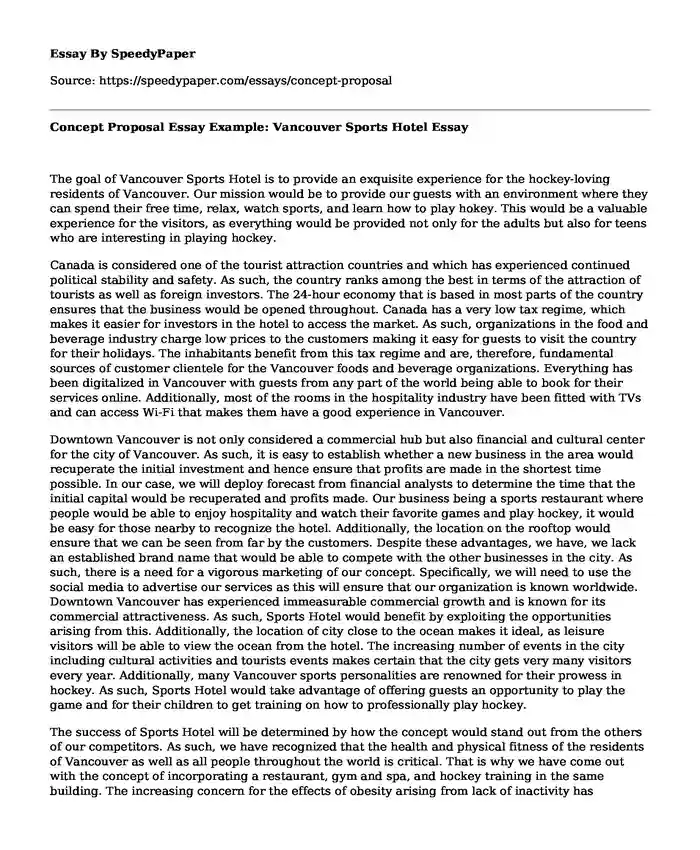
Analyze a few essays, paying attention to the structure of the text, formatting aspects, thesis statements, evidence, and implementation details. Do not copy sample content directly. Instead, use examples to understand how a proposal moves from problem to solution.
Proposal-related sample papers to review
The examples below can help you see how different proposal topics are developed across academic, business, health, and social contexts.
- The change and construction of the roads
- Uniform policy change
- Exam-oriented education
- Vancouver sports hotel
- Internal communication systems within an organization
- High turnover rate issue
- Implementation plan for evidence-based practice
- Research proposal on waste management
- Developing a prevention plan for possession of dangerous drugs
- Management in the hospitality industry
- Correctional officers and juveniles with mental illnesses
- Effect of self-efficacy on procrastination
- Computer science project proposal
- Digital marketing proposal essay
- Implementation of the proposal essay
Conclusion
Writing a proposal essay becomes easier when you treat it as a practical problem-solution argument. Start with a focused issue, explain why it matters, present a realistic solution, and show how that solution could be implemented. Then strengthen your proposal with credible evidence, expected outcomes, and responses to possible objections.
Before submitting your paper, check your assignment instructions, required format, citation style, and word count. A clear outline, specific thesis statement, and realistic implementation plan will make your proposal more persuasive and easier for readers to follow.
FAQ
What is the main goal of a proposal essay?
The goal is to convince the reader that a problem matters and that your proposed solution is realistic and worth supporting.
Is a proposal essay the same as a research proposal?
No. A proposal essay argues for a solution to a problem, while a research proposal explains a study you plan to conduct. A proposal essay usually focuses on action, feasibility, and expected outcomes. A research proposal focuses on research questions, methodology, literature, and academic contribution.
What are the three parts of a proposal essay?
Most proposal essays include an introduction, a body, and a conclusion. In practice, the body should cover the problem statement, proposed solution, implementation plan, feasibility, expected outcomes, and possible objections.
How long should a proposal essay be?
A proposal essay is often 800–1,200 words, but the best length is the one your assignment requires. Always follow your professor’s instructions for word count, citation style, and required sections.
What should a proposal essay thesis include?
A proposal essay thesis should name the problem and present the proposed solution. For example: “To reduce food waste on campus, the university should introduce a dining hall donation program that sends unused prepared food to local shelters each evening.”
What are common mistakes in proposal essays?
Common mistakes include choosing a topic that’s too broad, offering vague solutions, ignoring feasibility, skipping counterarguments, and failing to explain how the proposed solution will work in real conditions.
Related articles